Clara Schmidt · 2 October 2026
Bacterial Enzymes Reshape Chemical Signal Longevity Across Temperate Woodland Insect Routes
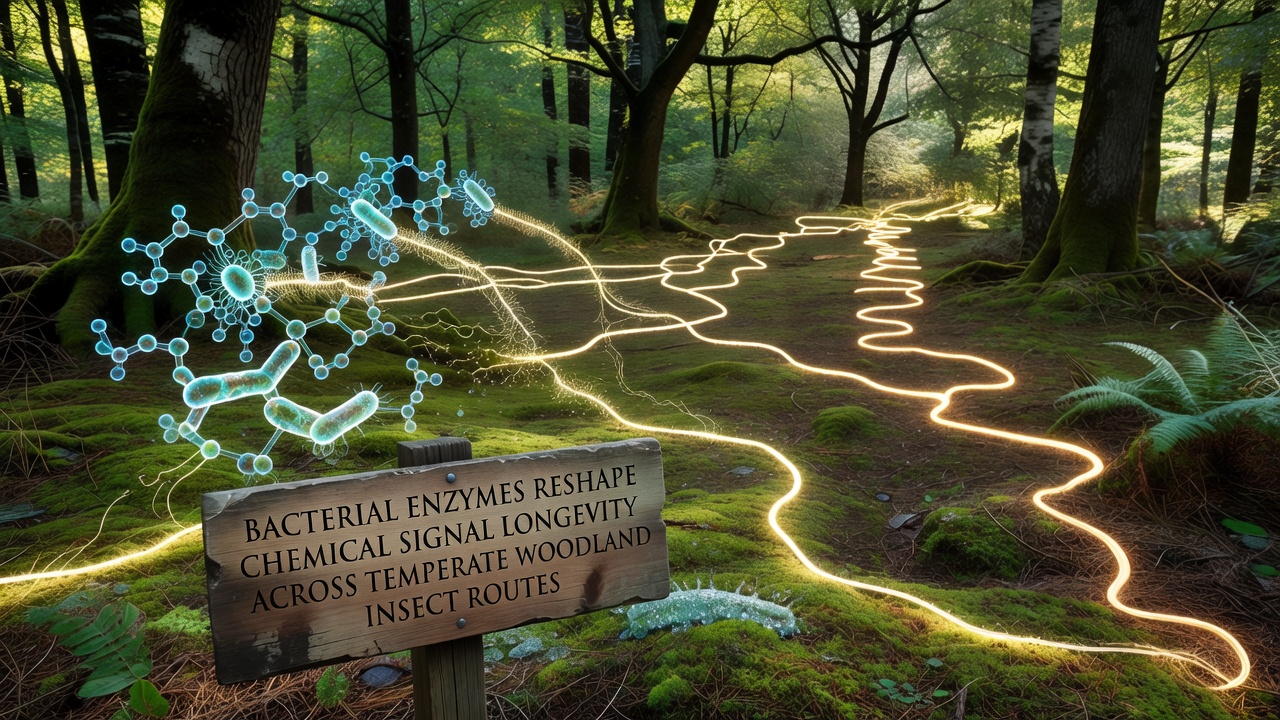
Researchers have documented how bacterial enzymes modify the persistence of chemical signals that guide insects through temperate woodland networks, and these modifications alter route stability in measurable ways. Data collected across multiple European and North American sites show that enzyme activity shortens or extends signal duration depending on soil temperature, moisture levels, and microbial community composition. Studies conducted through 2025 and into October 2026 indicate that certain bacterial strains produce proteases and lipases capable of cleaving pheromone molecules within hours of deposition, while other strains stabilize signals by neutralizing competing compounds.
Microbial Mechanisms at Work
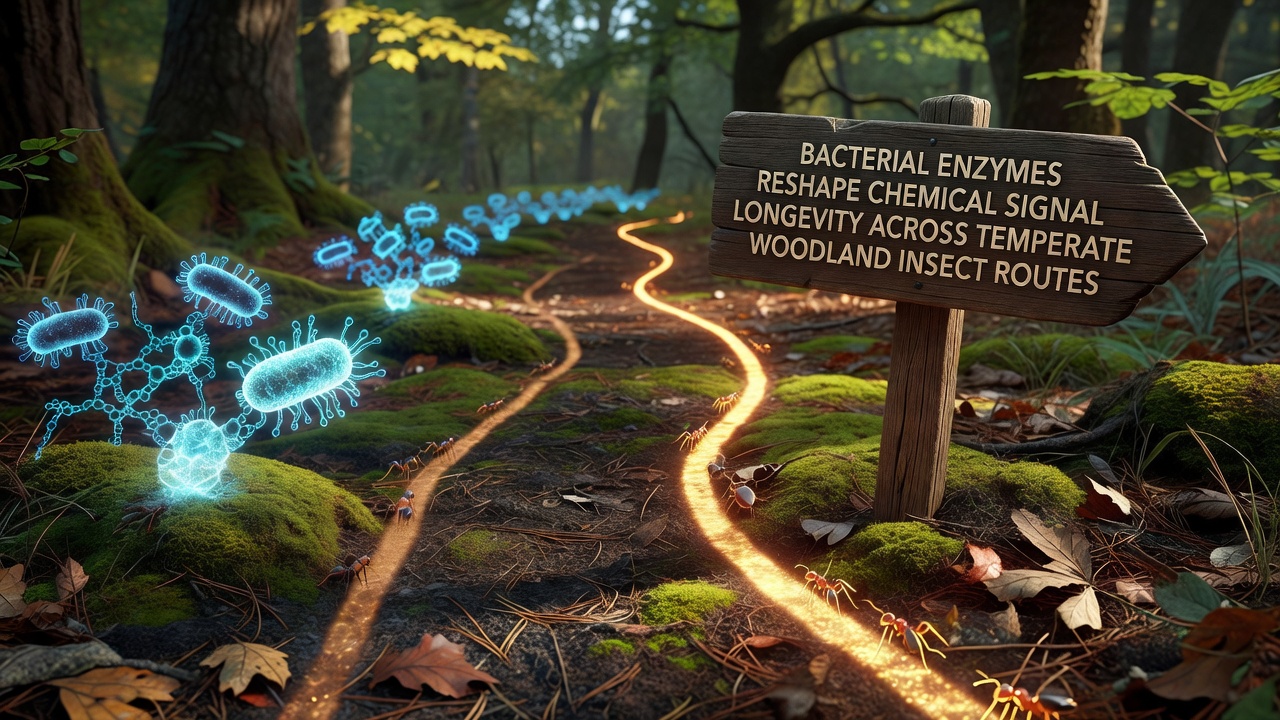
Enzymes released by soil bacteria interact directly with trail pheromones deposited by foraging insects such as beetles and wasps, and this interaction determines how long a given route remains detectable to subsequent individuals. Laboratory assays reveal that beta-glucuronidase and esterase variants accelerate the breakdown of fatty acid chains that form the backbone of many insect signals, reducing effective trail longevity from several days to less than twelve hours under warm, humid conditions. Field observations in mixed oak and beech stands confirm that sites with higher populations of Pseudomonas and Bacillus species exhibit faster signal decay rates compared to areas dominated by slower-metabolizing Actinobacteria.
Seasonal shifts further modulate these patterns because enzyme expression peaks during autumn leaf fall when organic substrate availability increases, and researchers note corresponding changes in route persistence across monitored transects. October 2026 sampling campaigns across the Appalachian foothills and the Carpathian foothills recorded a 30 percent reduction in average signal half-life relative to midsummer baselines, correlating with measured rises in extracellular enzyme concentrations.
Route Dynamics and Insect Behavior
Insects adjust their movement patterns when chemical cues degrade more rapidly, and telemetry data from tagged individuals demonstrate increased path redundancy as workers explore alternative corridors once established trails lose potency. In one multi-year study covering 12 hectares of secondary woodland, route overlap decreased by 22 percent during periods of elevated bacterial activity, forcing insects to maintain broader spatial coverage. This behavioral adjustment carries energetic costs yet also reduces competition at depleted resource patches.
Comparative analysis between managed and unmanaged woodland parcels shows that disturbance regimes influence bacterial community structure and therefore signal longevity, and plots subjected to selective thinning host microbial assemblages with higher protease output. Those same plots display shorter average trail durations, prompting insects to shift toward less disturbed zones where signals persist longer. Data from the US Forest Service experimental forests support these observations while parallel work by Environment and Climate Change Canada links canopy density to enzyme diffusion rates through the litter layer.
Environmental Factors and Geographic Variation
Temperature gradients across latitude produce distinct enzyme kinetics, and temperate sites at 45 to 55 degrees north experience peak degradation activity between 18 and 24 degrees Celsius. Below 12 degrees Celsius, most recorded bacterial strains reduce output, allowing chemical signals to remain functional for up to 72 hours. Moisture thresholds also matter because water films facilitate enzyme-substrate contact, and drought periods extend signal persistence even when bacterial abundance remains constant.
Researchers tracking routes across the UK Lake District and the Polish Bieszczady mountains report similar temperature-enzyme relationships despite differences in dominant tree species and insect taxa. These cross-regional patterns suggest that microbial control of chemical longevity operates as a general process rather than a localized anomaly. Ongoing monitoring programs now incorporate real-time enzyme assays to forecast route stability under projected climate scenarios.
Implications for Woodland Ecosystems
Altered signal longevity affects not only individual navigation but also resource distribution and predator-prey encounters throughout the woodland food web. When trails evaporate quickly, insects concentrate less intensely at single food sources, which can reduce depletion rates yet increase exposure to ground-foraging vertebrates. Pollen and spore transport may shift accordingly as insects follow shorter-lived chemical corridors.
October 2026 workshops hosted by the European Forest Institute highlighted how these microbial-insect interactions could inform predictive models of woodland connectivity under changing land-use pressures. Participants reviewed datasets showing that enzyme-mediated signal loss correlates with measurable declines in recruitment success for certain beetle species during late-season foraging bouts.
Conclusion
Bacterial enzymes exert measurable control over chemical signal duration across temperate woodland insect routes, and this control varies with temperature, moisture, and microbial composition. Field and laboratory evidence compiled through October 2026 demonstrates consistent geographic patterns while revealing seasonal fluctuations tied to substrate availability. Continued integration of enzyme assays into ecological monitoring will refine understanding of how these microscopic processes shape macroscopic movement networks.