Olivia Beck · 16 October 2026
Ants Blend Visual Cues With Scent Marks to Navigate Open Meadow Expanses in Variable Weather Conditions
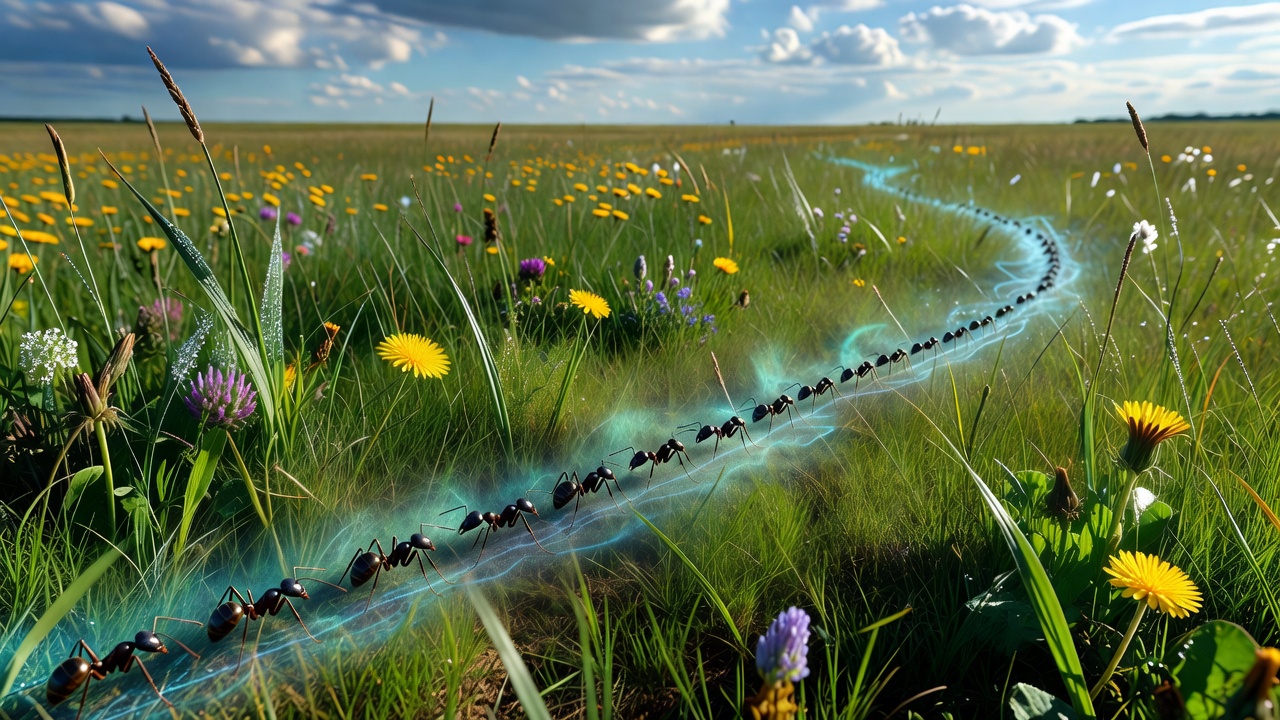
Ants in expansive meadows rely on a combination of visual landmarks and chemical scent marks when moving across open ground where wind and precipitation shift rapidly, according to field observations compiled by entomologists at multiple research stations. These insects deposit pheromone trails that provide directional information, yet the same trails degrade quickly when gusts exceed typical thresholds or when moisture levels rise after showers. Observers note that ants compensate by scanning for stable features such as tall grass stems, rock outcrops, and flower clusters that remain visible even as scent intensity fluctuates.
Data collected across several temperate grassland sites indicates that individual foragers adjust their reliance on each cue type within minutes of environmental change. When wind speeds increase, trail pheromones disperse faster, prompting ants to orient more frequently toward distant silhouettes on the horizon. Conversely, during periods of low visibility caused by fog or heavy cloud cover, workers slow their pace and spend additional time antennating the substrate to detect residual chemical signals that persist in sheltered microhabitats.
Mechanisms of Cue Integration
Researchers have documented that ants maintain an internal representation that merges both modalities rather than switching exclusively between them. Laboratory assays paired with outdoor tracking reveal that foragers trained on routes marked by both visual arrays and scent lines continue to follow the combined path even after one cue is experimentally removed. This dual encoding allows colonies to sustain foraging efficiency across meadow patches where weather fronts arrive without warning.
Studies conducted in North American prairie reserves show that species such as Formica podzolica maintain consistent return rates to nest entrances when both cue types remain available, whereas performance drops when either visual or olfactory information is disrupted alone. Similar patterns appear in Australian grassland populations of Iridomyrmex purpureus, where individuals use polarized light patterns above the canopy as an additional visual reference when ground-level scents wash away after rain.
Weather-Driven Adjustments Observed in 2026
Monitoring efforts that extended into October 2026 recorded elevated use of visual scanning among meadow ants following successive storm systems that stripped volatile compounds from exposed soil surfaces. Teams equipped with portable anemometers and scent-detector arrays noted that foragers increased head movements consistent with landmark fixation during the hours immediately after rainfall, while trail reinforcement activity resumed only after surfaces dried sufficiently for new deposits to adhere. These shifts occurred across multiple colonies and coincided with measurable drops in pheromone longevity recorded by gas chromatography samples taken at ground level.

European grassland projects have reported comparable flexibility, with workers of Lasius niger demonstrating rapid recalibration when artificial wind tunnels simulated gusts typical of autumn fronts. In those controlled settings, ants that had previously relied heavily on scent marks began prioritizing the position of artificial landmarks placed at intervals matching natural meadow features. The transition occurred without interruption to overall traffic flow, suggesting an integrated decision process rather than a complete override of one system by the other.
Colony-Level Patterns and Foraging Continuity
Long-term mapping of trail networks in open meadows reveals that colonies establish primary routes along lines where visual and chemical cues overlap most reliably. Secondary paths appear in zones where one cue type predominates, allowing workers to reroute when primary corridors become compromised. Such redundancy supports sustained resource collection even as daily weather cycles alter cue availability.
Observations from Canadian prairie research stations indicate that larger colonies maintain higher numbers of scouts capable of updating both visual and olfactory information simultaneously. These scouts deposit fresh marks at junctions where landmarks intersect existing trails, creating nodes that subsequent foragers can recognize under varied light and moisture regimes. Smaller colonies exhibit similar behaviors but at reduced spatial scales, concentrating activity nearer to nest entrances where cue stability remains higher.
Implications for Broader Insect Navigation Research
Findings from meadow systems contribute to ongoing investigations into multimodal orientation across insect taxa. Data compiled by the Commonwealth Scientific and Industrial Research Organisation in Australia and by prairie ecology programs in the United States demonstrate that cue blending occurs in other open-habitat species facing comparable environmental variability. These cross-regional comparisons highlight conserved mechanisms that permit navigation when single sensory channels become unreliable.
Continued tracking through changing seasons shows that ants refine their cue-weighting strategies based on prior exposure to specific weather sequences. Colonies experiencing repeated wind events strengthen visual associations along established paths, while those encountering frequent precipitation invest more in rapid trail renewal once surfaces stabilize. Such adaptive tuning occurs without central coordination, emerging instead from individual responses that propagate through the foraging workforce.
Conclusion
Ant navigation in variable meadow conditions rests on simultaneous processing of visual landmarks and scent marks that together buffer against rapid weather shifts. Field measurements and experimental manipulations confirm that foragers adjust emphasis between the two systems within short time frames, preserving route fidelity across fluctuating conditions. Ongoing monitoring programs continue to quantify how these adjustments scale from individual decisions to colony-level trail maintenance in grassland environments worldwide.